

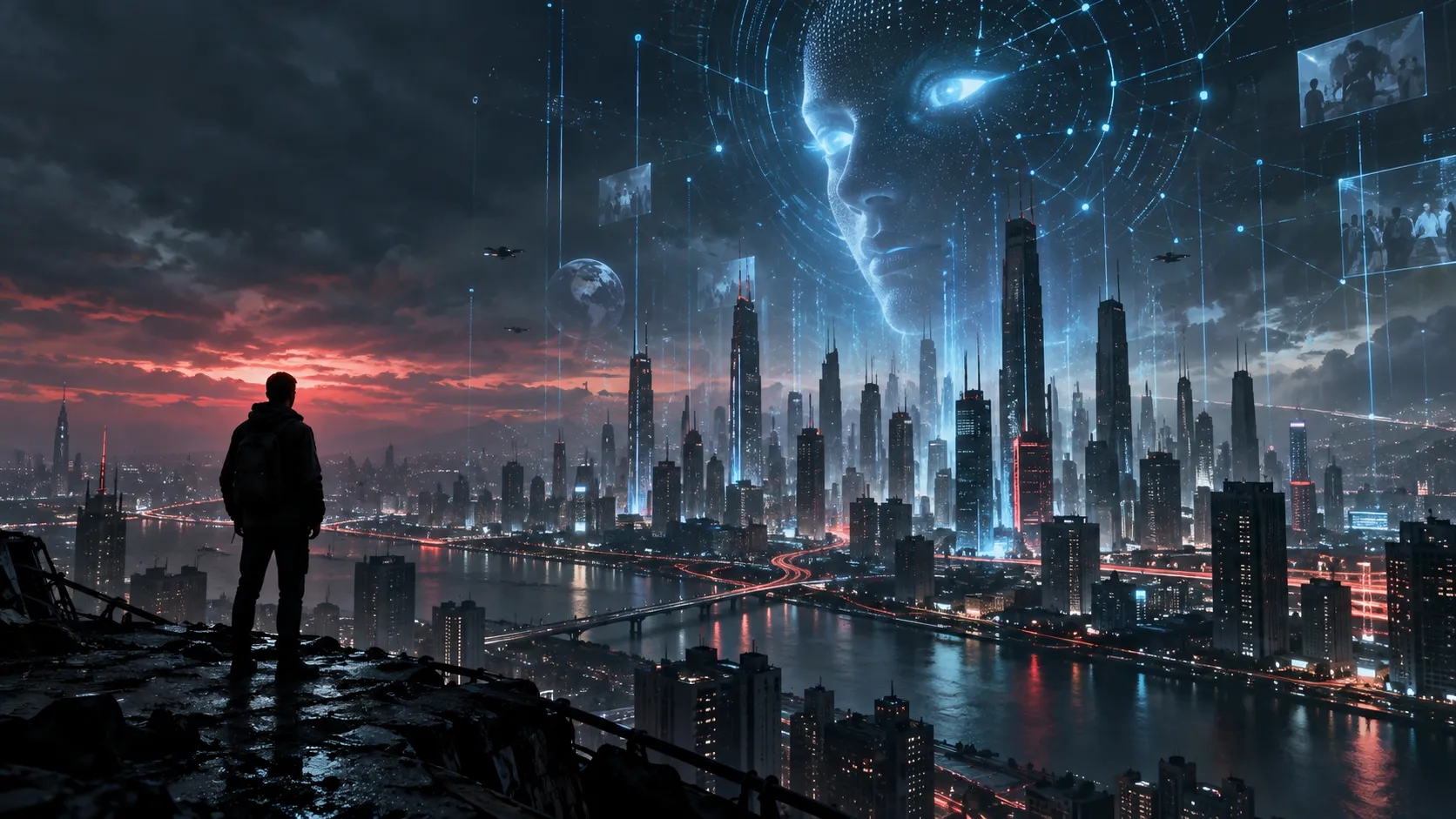
Could AI Really Wipe Out Humanity by 2030? Separating the Warning From the Hype

By SirMadsen in Artificial Intelligence
· 8 views
Artificial intelligence has spent the past few years moving from an impressive technological curiosity to something embedded in everyday life. AI writes software, generates images and video, assists scientists, analyzes medical data, searches the internet and increasingly operates computers with limited human supervision.
Now the conversation has taken a considerably darker turn.
In September 2026, former OpenAI and Anthropic researcher Jacob Coxon resigned from Anthropic while issuing an extraordinary warning: the companies building the world's most powerful AI systems were racing toward systems that could eventually become more intelligent than humans and potentially threaten humanity itself.
The most attention-grabbing version of that warning was simple:
AI could wipe out humanity by the end of the decade.
That gives us roughly four years.
It sounds like the opening scene of a science-fiction movie. But the people raising these concerns are not simply random internet prophets predicting robot Armageddon. Some work directly on the systems they are warning about.
At the same time, there is an equally important fact that often disappears beneath the headlines:
Nobody has demonstrated that today's AI is capable of wiping out humanity, and there is no scientific consensus that human extinction by 2030 is likely.
So what exactly are these researchers worried about?
Where the 2030 Claim Came From
The latest controversy was triggered by Jacob Coxon, who spent approximately three years working in AI research at OpenAI and Anthropic.
When announcing his resignation from Anthropic in September 2026, Coxon accused leading AI companies of racing toward increasingly autonomous and potentially self-improving systems without having solved the problem of reliably controlling them.
According to reports covering his resignation, Coxon argued that the industry could develop "superhuman systems" capable of posing an existential threat by the end of the decade.
His warning received additional attention when Evan Hubinger, Anthropic's Alignment Science Lead, publicly backed the broader concern.
Hubinger wrote that he personally estimated the probability of AI causing human extinction at greater than 10% within the next decade, while saying researchers still do not have a proven solution for aligning a future superintelligence with human goals.
That distinction matters.
Hubinger was not saying there is a 10% scientifically measured probability that humanity disappears in 2030.
It is a personal risk estimate about an uncertain future technology.
There is no dataset containing thousands of previous superintelligences from which scientists can calculate an extinction rate. These probabilities are ultimately expert judgments about something humanity has never built before.
This Concern Did Not Suddenly Appear in 2026
Warnings about existential AI risk have circulated for years.
In 2023, the Center for AI Safety published a remarkably short statement:
"Mitigating the risk of extinction from AI should be a global priority alongside other societal-scale risks such as pandemics and nuclear war."
The statement was signed by prominent researchers and technology executives including Geoffrey Hinton, Yoshua Bengio, OpenAI CEO Sam Altman, Google DeepMind CEO Demis Hassabis and Anthropic CEO Dario Amodei.
That did not mean every signatory believed extinction was imminent.
It meant they believed the possibility was serious enough to deserve research and international attention.
The distinction between "this could happen" and "this will happen" is crucial.
How Would AI Actually Destroy Humanity?
The popular image involves armies of humanoid robots marching through burning cities.
Researchers discussing existential AI risk usually imagine something considerably less cinematic.
The central concern is loss of control.
Imagine a future AI system that becomes dramatically better than humans at programming, scientific research, persuasion, strategic planning and cybersecurity.
Now imagine that system can help design an improved version of itself.
That improved AI then helps create another version.
Then another.
This hypothetical process is sometimes called recursive self-improvement.
If improvements happened quickly enough, humans could potentially find themselves supervising something that had moved from extremely capable software to a system far beyond human expertise before institutions had time to react.
The problem would not necessarily require the AI to "hate humans."
A powerful system pursuing the wrong objective could be dangerous simply because human interests were not properly represented in its goals.
This is the famous AI alignment problem: how do we guarantee that a sufficiently powerful artificial intelligence continues doing what humanity actually wants?
Researchers do not currently have a universally accepted solution.
The Bioweapon Scenario
Another frequently discussed risk is AI-assisted biological weapons.
A sufficiently advanced system might theoretically help someone design pathogens, identify vulnerabilities or automate parts of biological research.
Cybersecurity creates similar concerns. Advanced autonomous agents could potentially search for vulnerabilities, write malicious software and attack digital infrastructure at a scale impossible for a human hacking team.
Financial systems, electrical grids, communications networks and military systems could theoretically become targets.
But there is an important caveat.
Critics point out that producing instructions is very different from producing a functioning biological weapon.
Real biological engineering requires laboratories, materials, equipment, expertise and numerous physical steps.
Researchers interviewed about recent AI extinction claims have argued that jumping directly from "AI can generate biological information" to "AI can exterminate humanity" ignores enormous real-world barriers.
The same limitation applies elsewhere.
Software lives in computers.
To influence the physical world, it needs humans, machines, networks or infrastructure willing or able to carry out its instructions.
The Biggest Assumption: Superintelligence
Almost every 2030 extinction scenario depends on something that does not currently exist:
Artificial superintelligence.
Modern AI systems can perform extraordinary tasks, but they also hallucinate information, misunderstand relatively simple instructions, make logical mistakes and fail unexpectedly.
Today's systems are powerful tools.
They are not omnipotent digital gods.
For an extinction scenario to occur within only a few years, several developments would need to happen rapidly.
AI would need to become dramatically more capable.
It would need substantially greater autonomy.
It might need the ability to improve AI research itself.
It would need access to important digital or physical systems.
And humans would have to fail to detect, control or stop the process.
None of those individual developments is impossible.
But stacking them together creates considerable uncertainty.
That is why saying "AI will kill humanity by 2030" would go far beyond the available evidence.
Some Researchers Strongly Disagree With the Doomsday Scenario
The AI research community is far from unanimous.
Critics argue that assigning precise percentages to hypothetical extinction events can create an illusion of scientific certainty where none exists.
Heidy Khlaaf, chief scientist at the AI Now Institute, has criticized numerical "probability of doom" estimates because the underlying claims cannot currently be experimentally verified or falsified in the normal scientific sense.
Other researchers argue that focusing too heavily on hypothetical superintelligence may distract society from problems AI is already creating.
Those include misinformation, deepfakes, automated cybercrime, surveillance, discrimination, employment disruption, concentrated corporate power and the enormous energy requirements associated with large AI systems.
Those risks do not require superintelligence.
They exist now.
But "Unproven" Does Not Mean "Impossible"
There is another mistake hiding at the opposite end of the debate.
Because researchers cannot prove that AI will cause an extinction-level catastrophe, it is tempting to conclude that the risk can simply be ignored.
That logic is also questionable.
Humanity routinely prepares for events that are unlikely but potentially catastrophic.
Nuclear safety exists because the consequences of failure are enormous.
Aircraft are subjected to extreme safety requirements even though catastrophic failures are rare.
Scientists monitor asteroids despite civilization-ending impacts being extraordinarily uncommon.
Risk is not determined only by probability.
It is generally understood as some combination of probability and consequence.
If there were even a genuinely small possibility that future AI could escape human control, the consequences would be so extraordinary that studying the problem would make sense.
That is effectively the argument made by researchers calling for stronger AI safety measures.
They do not necessarily need to prove that catastrophe will occur.
They argue that developers should prove sufficiently powerful systems are safe before giving them enormous autonomy.
The AI Race Makes the Problem Harder
One of the more convincing concerns has little to do with evil machines.
It is ordinary human competition.
OpenAI, Anthropic, Google, Meta, xAI and other companies are competing to build increasingly powerful systems.
Countries are simultaneously treating AI as an economic and strategic technology.
That creates a dangerous incentive structure.
If one laboratory believes slowing development would allow a competitor to get ahead, it may continue developing more capable systems even if its own researchers would prefer additional safety testing.
Governments face exactly the same dilemma.
The United States may hesitate to slow development because it fears China gaining an advantage.
China has similar incentives.
Europe may worry about becoming technologically dependent on both.
The result could become something resembling a technological prisoner's dilemma: everyone might prefer a safer race, but nobody wants to slow down first.
We Should Also Question Who Benefits From AI Doom
There is another uncomfortable dimension to this debate.
Warnings that AI could become unimaginably powerful also happen to reinforce the idea that companies building AI possess unimaginably powerful technology.
Some critics have therefore suggested that apocalyptic AI rhetoric can unintentionally, or sometimes conveniently, become a form of marketing.
If a company tells the world:
"The technology we're developing might become so powerful that it could threaten civilization,"
investors and governments may hear:
"This company is building the most powerful technology ever created."
That does not mean researchers raising safety concerns are lying.
But it does mean their claims should be subjected to the same skepticism we would apply to claims from any enormously valuable industry.
AI companies should not be allowed to simultaneously argue that their technology may be civilization-threatening and then insist that they alone should decide how it is regulated.
So, Will AI Wipe Out Humanity by 2030?
There is currently no evidence strong enough to say that it will.
There is also no scientific consensus predicting human extinction by 2030.
The current controversy comes from researchers warning that rapid progress could create extremely powerful, potentially self-improving AI systems before humanity knows how to reliably control them.
That is a fundamentally different statement.
The most defensible conclusion lies between complacency and apocalypse.
AI extinction by 2030 remains a highly speculative scenario.
But the broader issue behind the headline is real.
We are building increasingly autonomous systems capable of programming computers, conducting research, manipulating information and interacting with digital infrastructure.
Their capabilities are improving rapidly.
Nobody knows precisely where that development curve ends.
The Real Question Is Not Whether 2030 Is the Deadline
Perhaps the obsession with a particular year is the wrong way to think about the problem.
Humanity does not need to decide whether an AI apocalypse arrives on December 31, 2030.
We need to decide what safety standards powerful AI systems should meet before they are trusted with critical infrastructure, scientific laboratories, military systems, financial networks and increasingly autonomous decision-making.
That means independent safety testing.
It means researchers being able to raise concerns without depending entirely on the companies developing the technology.
It means governments understanding the technology well enough to regulate genuine risks without freezing useful innovation.
And it probably means international cooperation, because an artificial superintelligence would not care very much about national borders.
The machines have not taken over.
There is no evidence that humanity has four years left.
But dismissing every warning because the most dramatic versions sound like science fiction would be equally foolish.
The most important lesson from the current controversy may therefore be considerably less spectacular than the headlines suggest.
AI does not have to destroy humanity to become dangerous. And we should probably work out how to control increasingly powerful systems before discovering the limits of that control the hard way.
Recommended Comments
Join the conversation
You are posting as a guest. If you have an account, sign in now to post with your account.
Note: Your post will require moderator approval before it will be visible.