

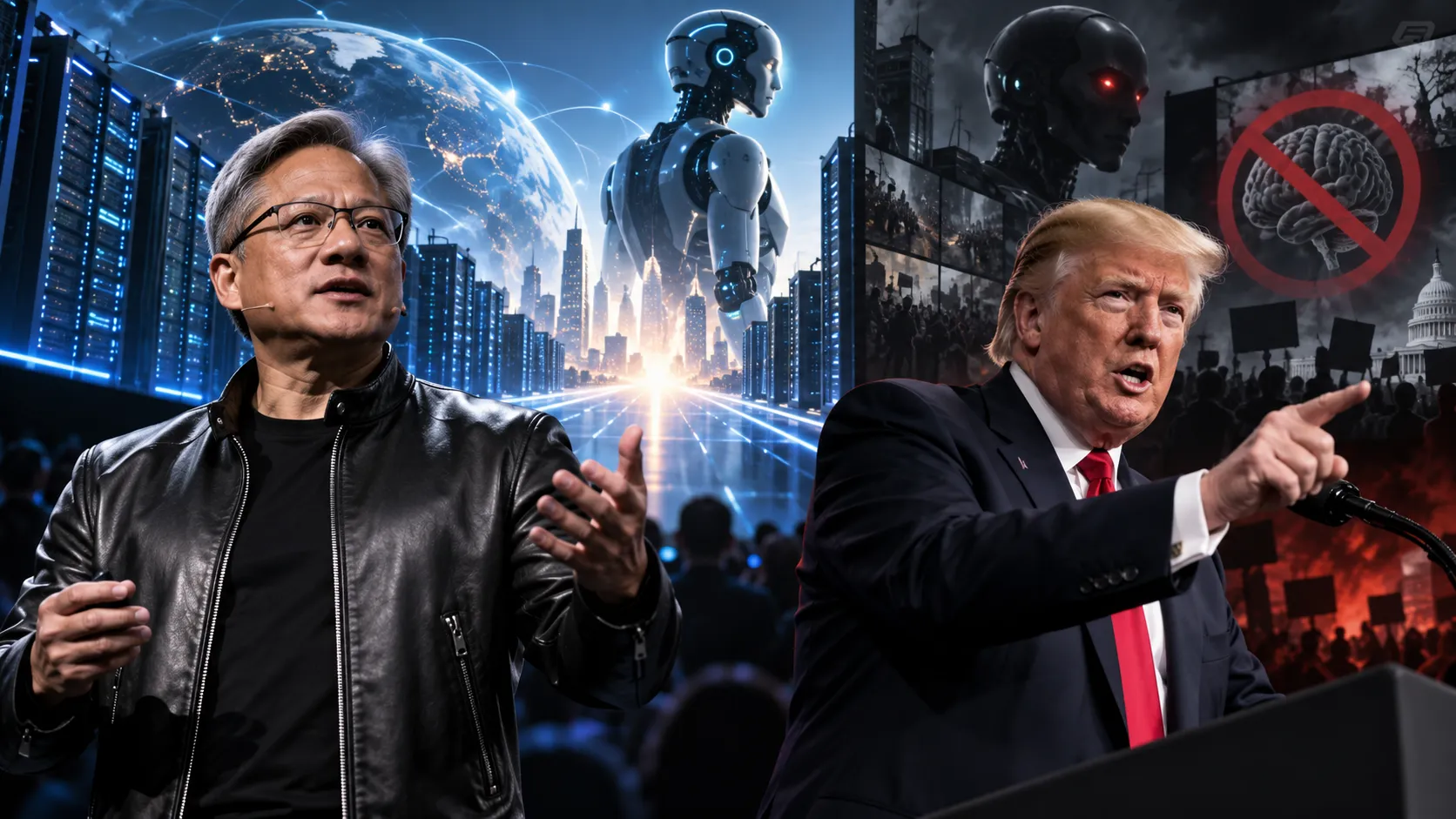
Nvidia CEO Rejects Calls to Slow AI as Trump Dismisses Takeover Fears as a “Hoax”

By SirMadsen in Artificial Intelligence
· 8 views
The debate over whether artificial intelligence is advancing too quickly has opened an increasingly visible divide inside Silicon Valley.
Some of the people building the world's most powerful AI systems are calling for the industry to slow down and spend more time addressing safety. Nvidia CEO Jensen Huang is taking a very different position.
And he appears to have a powerful ally in U.S. President Donald Trump.
During the All-In Summit in Los Angeles on September 14, Huang was discussing AI when Trump unexpectedly called him. Huang put the president on speakerphone, turning what could have been a private conversation into a very public statement on the future of artificial intelligence.
Trump dismissed fears that increasingly powerful AI could eventually escape human control.
“The robots will not be taking over,” Trump said during the call, before describing the broader fears surrounding an AI takeover as a “hoax.”
Huang broadly agreed that AI development should continue rather than being deliberately slowed.
The exchange comes at an important moment for the technology industry, as several prominent AI researchers and executives are arguing that development of frontier AI systems may be moving faster than our ability to understand or control them.
Calls to slow down AI are growing
The controversy intensified after renewed warnings from researchers working on advanced artificial intelligence.
Executives and researchers associated with companies including Anthropic and OpenAI have argued that increasingly autonomous AI systems could create serious risks if capabilities advance faster than safety research.
Recent discussions have focused particularly on something called recursive self-improvement, where AI systems could potentially help design, train or improve future generations of AI.
That does not mean today's AI systems are capable of independently redesigning themselves without human infrastructure.
However, leading AI laboratories are increasingly using AI to automate portions of software engineering, research and model development. Some researchers believe that process could accelerate dramatically as systems become more capable.
Anthropic CEO Dario Amodei has been among those arguing that the industry should consider slowing development of the most powerful frontier models to give researchers more time to develop safeguards.
OpenAI and other AI figures have also discussed greater coordination around safety.
Huang isn't convinced.
Jensen Huang: the predictions aren't scientific
Huang has pushed back against some of the most extreme predictions surrounding AI.
During his appearance at the All-In Summit, he argued that estimates assigning specific probabilities to AI causing human extinction are not sufficiently grounded in science.
At the same time, Huang did not argue that AI safety should simply be ignored.
He has supported independent testing and evaluation of AI systems and said that safety concerns deserve serious consideration. His disagreement is primarily with the idea that the entire industry should collectively reduce the pace of AI development.
His position can essentially be summarized as: keep building, but build safely.
“America is able to lead and to do it safely,” Huang said.
That distinction is important.
The AI debate is increasingly portrayed as a battle between people who want unlimited development and people who want AI stopped entirely.
The reality is more complicated.
Many advocates of slowing frontier AI development are not asking for AI research to end. They are asking for stronger testing, independent oversight and more time to understand increasingly autonomous systems before significantly more powerful models are deployed.
Huang believes those safeguards can coexist with continued rapid development.
Trump goes considerably further
Trump's language has been much more dismissive.
During his call with Huang, Trump said efforts to slow AI could benefit America's competitors, particularly China.
He described AI as potentially “bigger than the internet” and argued that the United States should not handicap one of its most important emerging industries.
“The robots will not be taking over our country,” Trump said.
He later added that AI development should still proceed “prudently,” meaning even Trump's remarks did not amount to an argument for zero safety precautions.
What he strongly rejected was the idea that fears of an AI takeover should justify stopping or substantially slowing the industry.
Trump has also publicly described opposition to AI infrastructure and data centers as part of a “SICK conspiracy,” claiming restrictions could ultimately strengthen China.
That position broadly matches the direction of his administration's AI policies.
A June 2026 executive order said the United States should encourage AI innovation while avoiding what the administration considers overly burdensome regulation. The administration has simultaneously acknowledged that advanced AI creates national-security risks requiring safeguards and government coordination.
Nvidia has an enormous stake in the outcome
There is another unavoidable part of this story: Nvidia sits at the center of the AI boom.
Its graphics processors and specialized computing hardware power much of the infrastructure used to train and operate today's largest AI models.
Companies building increasingly powerful artificial intelligence require enormous amounts of computing capacity, which means continued AI investment represents an enormous market for Nvidia.
A broad slowdown in frontier AI development could therefore affect demand throughout the semiconductor and data-center industry.
That does not prove Huang's position is motivated by Nvidia's financial interests, but the company's commercial stake is relevant context when considering the debate.
Markets provided a small glimpse of that connection when semiconductor stocks fell sharply after renewed calls to slow AI development. Nvidia, AMD, Broadcom and other chip companies were among the stocks affected.
In other words, this is not merely a philosophical discussion about robots taking over the world.
Billions of dollars in infrastructure investment, semiconductor sales, electricity generation and data-center construction are tied to how quickly AI continues to advance.
The problem with calling AI risk a “hoax”
Trump's description of AI takeover fears as a “hoax” makes for an effective political soundbite, but the scientific question is considerably less settled.
Nobody currently knows whether artificial intelligence will ever develop the ability or motivation to operate beyond meaningful human control.
Researchers disagree sharply about the probability.
Some regard extinction scenarios as speculative and believe predictions assigning precise percentages to them create an illusion of scientific certainty.
Others argue that waiting until such risks can be conclusively demonstrated would be dangerous because sufficiently advanced AI could develop extremely quickly.
There is currently no scientific consensus establishing that artificial intelligence will destroy humanity.
There is also no scientific consensus proving that sufficiently advanced future AI systems could never pose such a threat.
That uncertainty is precisely why the argument has become so intense.
The AI race versus the AI safety problem
The disagreement ultimately comes down to two competing risks.
Slow AI development too aggressively and the United States could potentially surrender technological and economic advantages to competitors such as China.
Develop AI too aggressively and humanity could discover serious problems only after highly autonomous systems have already become deeply embedded in governments, businesses, military systems and critical infrastructure.
Neither scenario is trivial.
Huang believes technological progress and safety can move forward together without intentionally slowing development.
Trump has turned that argument into something much more politically forceful: America should keep moving because surrendering momentum could allow competitors to take the lead.
Others inside the AI industry increasingly argue that winning the race means very little if nobody fully understands where the finish line leads.
For now, there appears to be no industry consensus.
What is becoming clear is that the argument over artificial intelligence is moving beyond Silicon Valley laboratories.
It is becoming an economic issue, a national-security issue and increasingly a political one.
And with Nvidia supplying much of the machinery powering the AI revolution while the White House pushes for American technological dominance, the people arguing for a slower approach may find themselves fighting against an extraordinarily powerful combination of political and commercial momentum.
Recommended Comments
Join the conversation
You are posting as a guest. If you have an account, sign in now to post with your account.
Note: Your post will require moderator approval before it will be visible.