

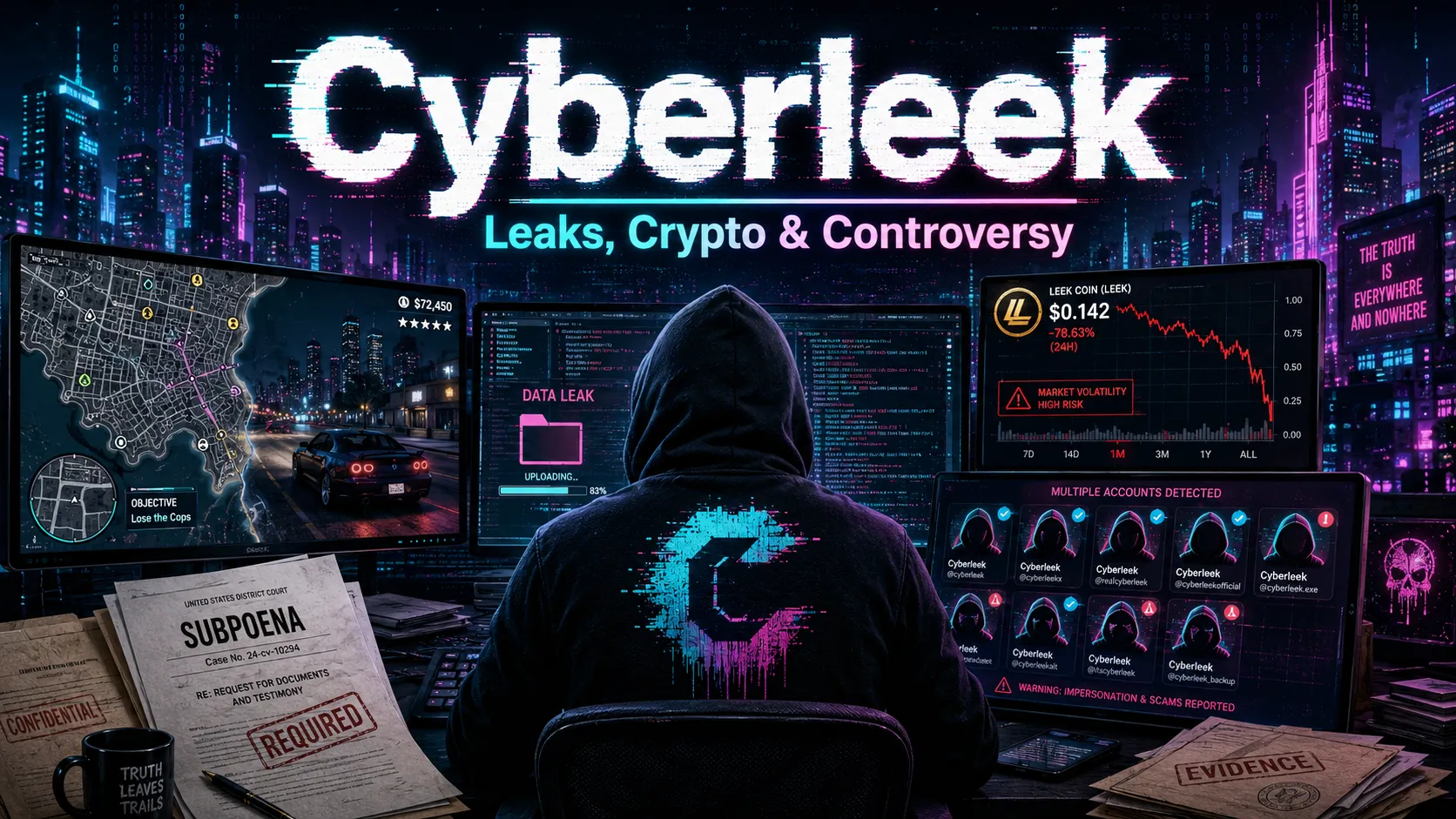
Cyberleek: GTA VI Leaks, Crypto Controversy and the Anonymous Figure Challenging Rockstar

For years, Rockstar Games has guarded Grand Theft Auto VI with the kind of secrecy normally reserved for unreleased technology or classified documents. Then, in August 2026, an anonymous online figure calling itself Cyberleek punched a sizeable hole through that wall.
What initially looked like another collection of gaming leaks quickly became something much stranger.
Unreleased GTA VI gameplay appeared online. A manifesto attacked modern gaming business practices. A cryptocurrency became intertwined with the leaks. Take-Two Interactive began pursuing information about people distributing the material. Impostor accounts appeared. And shortly before Rockstar finally presented its official extended look at the game, Cyberleek was accused of cashing out roughly a quarter of a million dollars connected to its crypto operation.
At this point, Cyberleek is no longer simply a GTA leaker. It has become one of gaming's most unusual controversies of 2026.
Who is Cyberleek?
Nobody publicly knows.
The Cyberleek name began attracting widespread attention around August 18, 2026, when previously unseen Grand Theft Auto VI gameplay footage started appearing online. Reporting indicates that the material included numerous gameplay clips, screenshots and portions of the game's map.
The footage appeared convincing enough that Rockstar and parent company Take-Two began issuing copyright takedowns against copies circulating online.
Rockstar later publicly acknowledged the leaks, saying that seeing unfinished material released in this way was not how the company wanted players to experience the game after years of development.
Despite plenty of internet detective work, Cyberleek's real identity remains unverified.
There have also been several social-media accounts using variations of the Cyberleek name, making attribution increasingly messy. Some accounts targeted by Take-Two's legal requests may even have been impersonators rather than the original source.
That distinction matters. Claims circulating online about the supposed identity, nationality or employment history of Cyberleek should therefore be treated as speculation unless independently confirmed.
The GTA VI leaks
The biggest controversy is naturally the leaked game itself.
Cyberleek released footage apparently showing a playable development build of GTA VI, primarily featuring protagonist Jason.
Reported clips showed activities ranging from driving and basketball to interaction with NPCs and previously unseen areas of Leonida. One particularly notorious leak showed a nudist community containing completely uncensored NPCs.
Fans began examining every frame for information about Rockstar's enormous open world.
But an interesting theory emerged as more footage appeared.
Almost everything focused on Jason rather than Lucia. Repeated tutorial prompts, similar equipment and other recurring elements led some observers to speculate that Cyberleek might have access to a limited or specially configured build rather than the entire finished game.
Cyberleek, meanwhile, suggested it possessed much more.
Exactly how the material was obtained has still not been publicly established.
The "Cyberleek Edict"
Cyberleek attempted to position the campaign as something larger than leaking a highly anticipated video game.
Its website published what it called the Cyberleek Edict, attacking practices including digital-only ownership, digital preorders, content locked behind additional purchases and games becoming unusable when publishers shut down online infrastructure.
Its public messaging presented Cyberleek as an anti-corporate movement fighting what it considered increasingly anti-consumer behavior within the games industry.
Some of those subjects reflect legitimate debates within gaming.
The preservation of online games, ownership of digital purchases and publishers removing access to purchased products have generated serious discussion among players, developers and preservation organizations.
But Cyberleek's campaign soon collided with another subject entirely.
Money.
Enter the $CYBERLEEK cryptocurrency
Alongside the leaks came a Solana-based cryptocurrency associated with the Cyberleek name.
Promotional material connected the value of the token to future leaks, with QR codes reportedly appearing directly inside leaked GTA footage. Some messaging effectively encouraged supporters to increase the token's market capitalization in return for additional material.
That immediately complicated Cyberleek's anti-corporate message.
Was this activism?
A fundraising campaign?
A speculative crypto project?
Or an elaborate way to monetize stolen or unauthorized material?
Cyberleek's own website explicitly insisted that the operation was not a cash grab and claimed funding would support infrastructure and an unspecified future project.
Then came the biggest controversy yet.
The alleged $250,000 cash-out
Shortly before Rockstar's official August 27 GTA VI presentation, reports emerged that Cyberleek had extracted approximately $250,000 connected to the $CYBERLEEK token.
According to reporting cited by Tom's Hardware, the money appears to have come primarily from liquidity-provider trading fees rather than simply dumping a huge personal token allocation onto buyers.
After the withdrawal, the token's price collapsed sharply.
Funds were subsequently distributed across several wallets, with portions reportedly moving through services intended to make blockchain tracing more difficult and some cryptocurrency reaching KuCoin-linked infrastructure.
Predictably, the word "rug pull" spread rapidly across gaming and crypto communities.
There is an important distinction, however.
A dramatic token collapse and a creator withdrawing money do not automatically prove criminal fraud. Calling the operation a scam is therefore an allegation unless investigators or courts establish otherwise.
But the incident badly damaged Cyberleek's carefully constructed anti-corporate persona.
A movement declaring itself opposed to exploitative monetization had, somewhat spectacularly, become entangled with one of the internet's most notoriously speculative forms of monetization.
The irony practically writes itself.
Take-Two goes hunting
Take-Two has not simply been playing digital whack-a-mole with leaked videos.
The company has pursued DMCA subpoenas seeking identifying information connected to distribution of the leaked footage.
According to TorrentFreak, legal requests have involved services including Microsoft, Discord, X and YouTube. The requests are designed to identify accounts associated with alleged copyright infringement rather than constituting lawsuits against Cyberleek itself.
The situation also demonstrates one of the weaknesses of anonymous leak campaigns.
A leaker may conceal their personal IP address or identity, but every service involved can create another breadcrumb: account records, hosting information, login metadata, exchange activity, blockchain transactions or communications with other users.
Cyberleek appears to have made considerable efforts to distribute information through decentralized infrastructure, but decentralizing the files does not necessarily decentralize every piece of evidence surrounding the person distributing them.
Rockstar finally takes control of the conversation
On August 27, Rockstar released its official 26-minute Grand Theft Auto VI: An Extended Look presentation.
The showcase revealed substantial gameplay involving both Jason and Lucia and provided fans with a far more polished look at Rockstar's vision for the game.
Ironically, the official presentation may have been one of the most damaging developments for Cyberleek.
Before August 27, unreleased gameplay was incredibly scarce.
After August 27, Rockstar itself had released nearly half an hour of professionally presented footage.
The information monopoly Cyberleek had briefly possessed suddenly became much less valuable.
Hacker, activist, marketer or opportunist?
That is ultimately what makes Cyberleek interesting.
The story contains several different identities layered on top of each other.
Cyberleek presents itself as a campaign against anti-consumer gaming practices.
To Rockstar and Take-Two, it is a source of unauthorized copyrighted material.
To GTA fans, it has alternated between forbidden information source, spoiler threat and internet spectacle.
And to cryptocurrency traders, Cyberleek became the face of another extremely volatile memecoin.
Whether this entire operation was primarily ideological, financial, attention-driven or some combination of all three remains impossible to establish without knowing who is actually behind it.
What can be established is that Cyberleek managed to turn a conventional videogame leak into something considerably larger.
Within less than two weeks, the name became associated with one of gaming's most anticipated releases, an anti-industry manifesto, decentralized hosting, a cryptocurrency frenzy, a six-figure cash-out controversy and a legal effort by one of the world's largest videogame publishers.
The GTA footage may eventually become little more than historical trivia once Grand Theft Auto VI launches on November 19, 2026.
The Cyberleek story, however, raises a more interesting question about modern leaks.
When anonymous leakers can combine stolen information, ideology, decentralized networks, social-media virality and cryptocurrency into one campaign, where exactly does whistleblowing or digital protest end and monetized spectacle begin?
Cyberleek may have started by leaking a game.
The controversy surrounding it has become a story about something much bigger.
Recommended Comments
Join the conversation
You are posting as a guest. If you have an account, sign in now to post with your account.
Note: Your post will require moderator approval before it will be visible.