

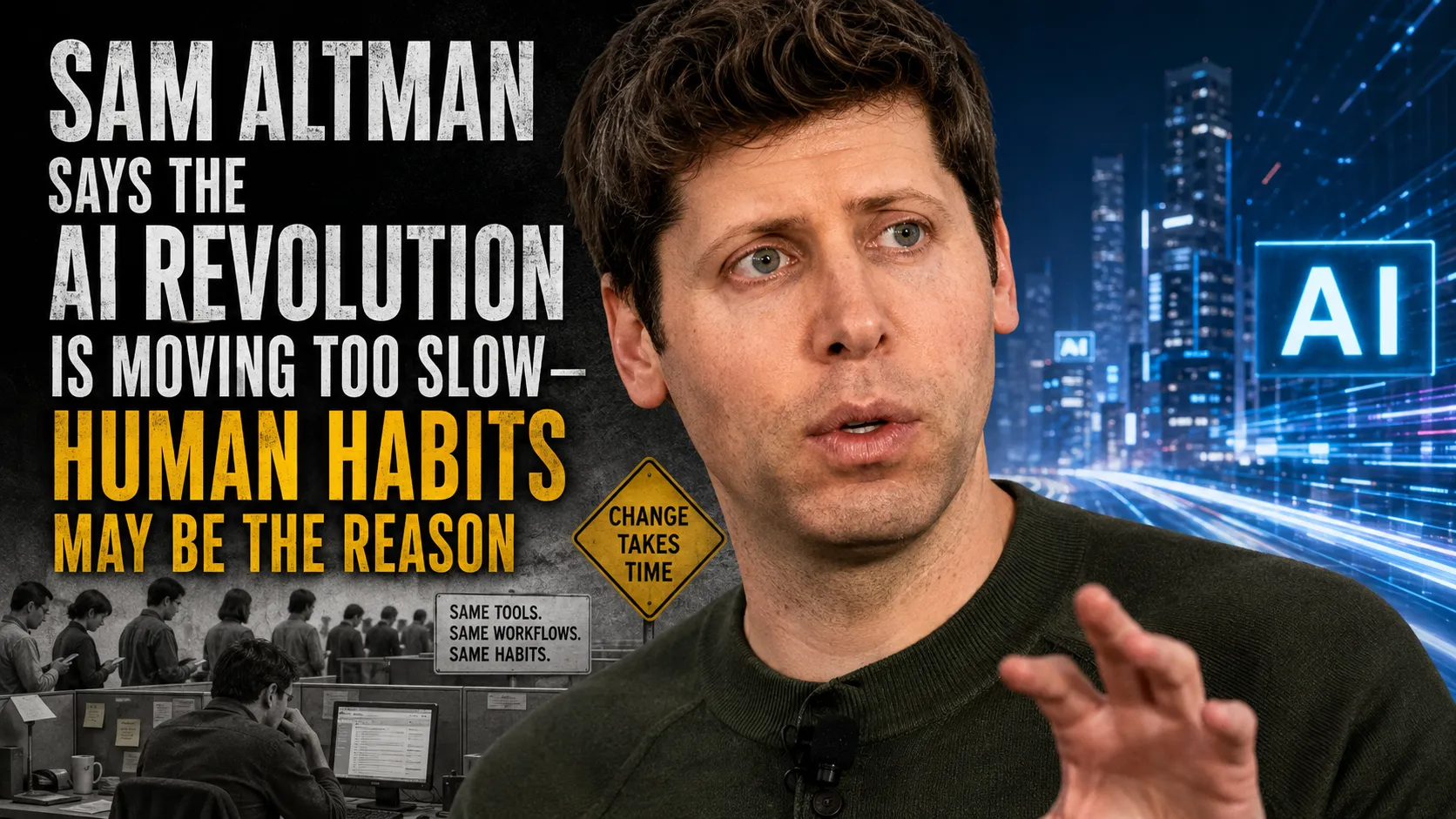
Sam Altman Says the AI Revolution Is Moving Too Slowly, and Human Habits May Be the Reason

By SirMadsen in Artificial Intelligence
· 189 views
Sam Altman
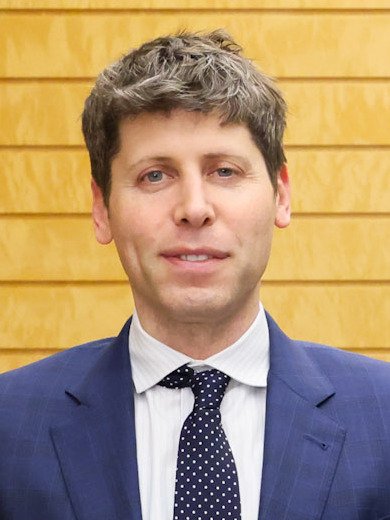
Samuel Harris Altman (born April 22, 1985) is an American entrepreneur and investor who has been the chief executive officer (CEO) of the artificial intelligence company OpenAI since 2019.
The artificial intelligence revolution was supposed to arrive like a thunderclap.
When OpenAI released GPT-4 in 2023, many people in Silicon Valley expected businesses to transform almost immediately. Existing software companies would suddenly face existential competition. Entire categories of work would be automated. Small teams armed with artificial intelligence would compete with corporations employing thousands of people.
Three years later, AI is certainly everywhere, but the economic revolution predicted by some of its biggest advocates has unfolded much more slowly.
OpenAI CEO Sam Altman now says he underestimated one surprisingly powerful obstacle: people simply do not change their habits very quickly.
In a recent conversation with podcaster David Senra, Altman admitted that his original expectations for the speed of the AI transition were too aggressive.
He had expected GPT-4 to trigger far more immediate disruption throughout the software industry.
Instead, something stubborn stood in the way.
Human behavior.
“People keep doing the same things they’re doing. They keep buying from the same company. They keep sort of wanting to use their tools in the same way.”
Altman described this resistance as economic “inertia,” arguing that even extremely powerful technology does not automatically convince people or companies to abandon the systems they already understand.
It is a fascinating admission from one of the most prominent architects of the AI boom.
But it also raises an uncomfortable question.
Is the public really slowing down the AI revolution, or has Silicon Valley underestimated how difficult it is to create technology that people actually want to reorganize their lives around?
The AI Revolution That Was Supposed to Happen Faster
After the arrival of ChatGPT and GPT-4, predictions about AI became increasingly dramatic.
Artificial intelligence would rewrite software development.
AI agents would replace conventional applications.
Companies could potentially operate with dramatically smaller workforces.
Entire industries might be rebuilt around language models capable of writing code, analyzing documents, answering questions and performing increasingly complex tasks.
Altman himself believed the software market would rapidly become more competitive.
Speaking with Senra, he recalled expecting that after GPT-4 arrived, significantly more software businesses would suddenly become vulnerable to AI-powered competitors.
That did not happen at the speed he expected.
Instead, companies continued renewing existing software contracts.
Employees continued opening the same applications.
Managers continued operating the same workflows.
People continued checking their email, copying information between applications and clicking through interfaces that AI could theoretically replace.
Altman's conclusion is surprisingly simple.
Technology can improve far faster than human behavior changes.
“I think we’ve all been too ambitious on timelines,” he said, adding that society and the economy will adapt more slowly than the underlying technology develops.
That statement represents a noticeable shift from some of the more explosive predictions surrounding generative AI only a few years ago.
The technology might still transform everything.
It might simply take longer.
The Blockbuster Problem
One analogy discussed during the interview perfectly illustrates Altman's argument.
Blockbuster.
When Netflix originally launched its DVD-by-mail business, customers could order movies without driving to a physical rental store.
From a purely technological or convenience perspective, Netflix appeared to offer an obvious advantage.
Yet millions of customers continued driving to Blockbuster.
Why?
Habit.
People already understood Blockbuster.
They knew where the store was.
They knew how renting a movie worked.
Saturday night might already involve driving there with the family and wandering between shelves looking for something to watch.
Technology had created a potentially better system, but human behavior had not immediately caught up.
Altman sees something similar happening with AI.
Even when AI can theoretically perform a task faster, people frequently continue doing things the familiar way.
The obstacle is not necessarily capability.
It is behavior.
Altman said changing behavior is considerably harder than people inside the technology industry sometimes realize.
And he has a rather awkward example.
Himself.
Even Sam Altman Isn't Fully Using the AI Revolution
Perhaps the most revealing moment in the conversation came when Altman discussed his own computer habits.
The CEO of OpenAI has access to some of the most sophisticated AI systems on Earth.
He has Codex.
He understands AI agents better than almost anyone.
Yet Altman admitted that much of the way he uses a computer has barely changed in roughly 20 years.
He still works through his inbox.
He still interacts with software in familiar ways.
He still performs tasks manually that an AI system could potentially automate.
That contradiction appears to have made him reconsider the problem.
If even the CEO of OpenAI struggles to reorganize his working habits around AI, perhaps expecting hundreds of millions of ordinary workers to immediately do so was unrealistic.
But Altman's conclusion was not simply that people are resistant to change.
He offered another explanation.
The products might not be good enough yet.
One account of the interview quotes Altman describing this as largely a “product failure.”
That distinction is important.
Because blaming customers for failing to adopt technology is easy.
Building technology compelling enough that customers willingly abandon old habits is much harder.
AI May Still Be Waiting for Its iPhone Moment
Altman compared today's AI industry to the smartphone market before the iPhone.
Before Apple's iPhone arrived in 2007, many of the individual technologies necessary for modern smartphones already existed.
There were mobile data connections.
Touchscreens existed.
Phones could run software.
Mobile email existed.
Web browsing existed.
Digital cameras were appearing in phones.
Yet those technologies had not been combined into a product that dramatically changed how ordinary people interacted with computers.
Then the iPhone arrived.
The important innovation was not necessarily the invention of every individual component.
It was packaging those technologies into something people immediately understood.
AI may still be waiting for that moment.
Today's chatbots are extraordinarily capable compared with software from only a few years ago, but most people still interact with them as separate destinations.
Open a chatbot. Type a question. Copy the answer. Paste it somewhere else. Return to another application.
The underlying AI may be revolutionary, but the workflow can still feel strangely old-fashioned.
The real AI revolution may arrive when people stop consciously “using AI” altogether.
Instead, intelligence could quietly become part of operating systems, applications, vehicles, workplaces and everyday devices.
At that point, AI adoption might accelerate dramatically because users would no longer need to change their behavior around the technology.
The technology would adapt to them.
But the Public Has Reasons to Be Cautious
There is another side to Altman's argument that Silicon Valley cannot simply dismiss as resistance to change.
A large portion of the public does not believe AI is moving too slowly.
They believe it is moving too quickly.
According to a 2026 Pew Research Center survey, 63 percent of American adults said AI was advancing too quickly.
Only 2 percent believed it was moving too slowly.
That is an extraordinary gap.
Another Pew survey conducted in June 2026 found that 52 percent of Americans were more concerned than excited about the increased use of AI, while only 9 percent were more excited than concerned.
The skepticism is not simply coming from older generations either.
Among Americans aged 18 to 29, 55 percent reported being more concerned than excited about AI in 2026.
That number has climbed substantially from 31 percent in 2021.
In other words, the resistance Altman describes may not simply be technological inertia.
Some of it is deliberate.
People are asking what happens to their jobs.
They are asking who controls AI systems.
They are asking how their personal information is being used.
They are questioning whether AI-generated content will damage creative industries.
And increasingly, communities are questioning the enormous infrastructure required to power artificial intelligence.
Data Centers Have Made AI Physical
For several years, artificial intelligence felt almost weightless.
You opened a website. Typed something. Received an answer.
Behind that seemingly simple interaction, however, sits one of the largest infrastructure expansions in the history of computing.
AI requires enormous data centers filled with specialized processors.
Those facilities require electricity, cooling systems, land, water and transmission infrastructure.
As AI infrastructure has expanded, the technology has become increasingly visible to communities that previously experienced AI primarily through software.
The reaction has not always been enthusiastic.
Local resistance to new data centers has become a significant political issue in the United States, with communities raising concerns about electricity prices, environmental impact, water consumption and whether the economic benefits justify the infrastructure being built around them.
This creates a strange collision between two worlds.
Silicon Valley sees compute.
Local communities see power lines, construction sites and utility bills.
Tech executives see infrastructure necessary for the next industrial revolution.
Residents may see an enormous building consuming resources while employing relatively few people.
That gap in perspective matters.
The Problem May Not Be the Public
It would therefore be misleading to summarize Altman's comments simply as “people are holding AI back.”
His argument is more interesting than that.
There are really several forces slowing the transition.
Human habits are one.
Corporate bureaucracy is another.
Existing software contracts matter.
Training workers takes time.
Regulations matter.
Trust matters.
The quality of AI products matters.
And public acceptance matters.
Technology companies frequently imagine technological progress as a straight line.
Invent something better.
Release it.
Watch the world adopt it.
History rarely works that way.
Electricity took decades to reorganize factories.
The automobile required roads, fuel stations, traffic laws and entirely new cities.
The internet existed long before most businesses understood what to do with it.
Smartphones required an ecosystem of applications, wireless networks and payment systems before they became the universal computers we recognize today.
AI may follow the same pattern.
The breakthrough happens first.
The transformation comes later.
Slower Might Actually Be Better
Perhaps the most surprising part of Altman's comments is that he does not necessarily view slower adoption as a disaster.
He described economic inertia as “a positive in many ways.”
The slower transition may give society more time to adapt.
Businesses can experiment.
Workers can learn new skills.
Governments can develop regulations.
Schools can reconsider how they teach.
Companies can figure out where AI genuinely improves productivity instead of inserting it into products merely because investors expect them to.
And AI developers themselves get more time to improve reliability, safety and usability.
Altman said he is actually grateful that the transition may happen more smoothly and slowly than originally expected.
That is a significantly different message from the feverish atmosphere surrounding AI in 2023 and 2024.
The revolution is still coming, according to Altman.
The timetable has simply changed.
Silicon Valley's Biggest AI Challenge May Be Human
There is an amusing irony buried inside the entire discussion.
Artificial intelligence companies have spent billions of dollars building machines capable of understanding human language.
Their next challenge may be understanding humans.
People are complicated.
We form routines.
We distrust unfamiliar systems.
We become emotionally attached to tools that technically should have disappeared years ago.
Businesses operate with contracts, regulations, legacy databases and employees who cannot simply rebuild their workflows every six months because a new model received a benchmark upgrade.
From inside an AI laboratory, technological capability might look exponential.
Outside that laboratory, society moves at the speed of institutions, habits and trust.
Those two clocks are not synchronized.
And that might explain why the AI revolution simultaneously feels extraordinarily fast and strangely slow.
AI models are advancing at astonishing speed.
Yet most offices still contain spreadsheets.
People still answer email.
Companies still buy software from vendors they have used for decades.
And even Sam Altman apparently still uses his computer much like he did before the AI revolution began.
Perhaps the public is slowing AI down.
Or perhaps Silicon Valley simply discovered one of technology's oldest lessons:
Inventing the future is easier than convincing billions of people to live in it.
Recommended Comments
Join the conversation
You are posting as a guest. If you have an account, sign in now to post with your account.
Note: Your post will require moderator approval before it will be visible.